


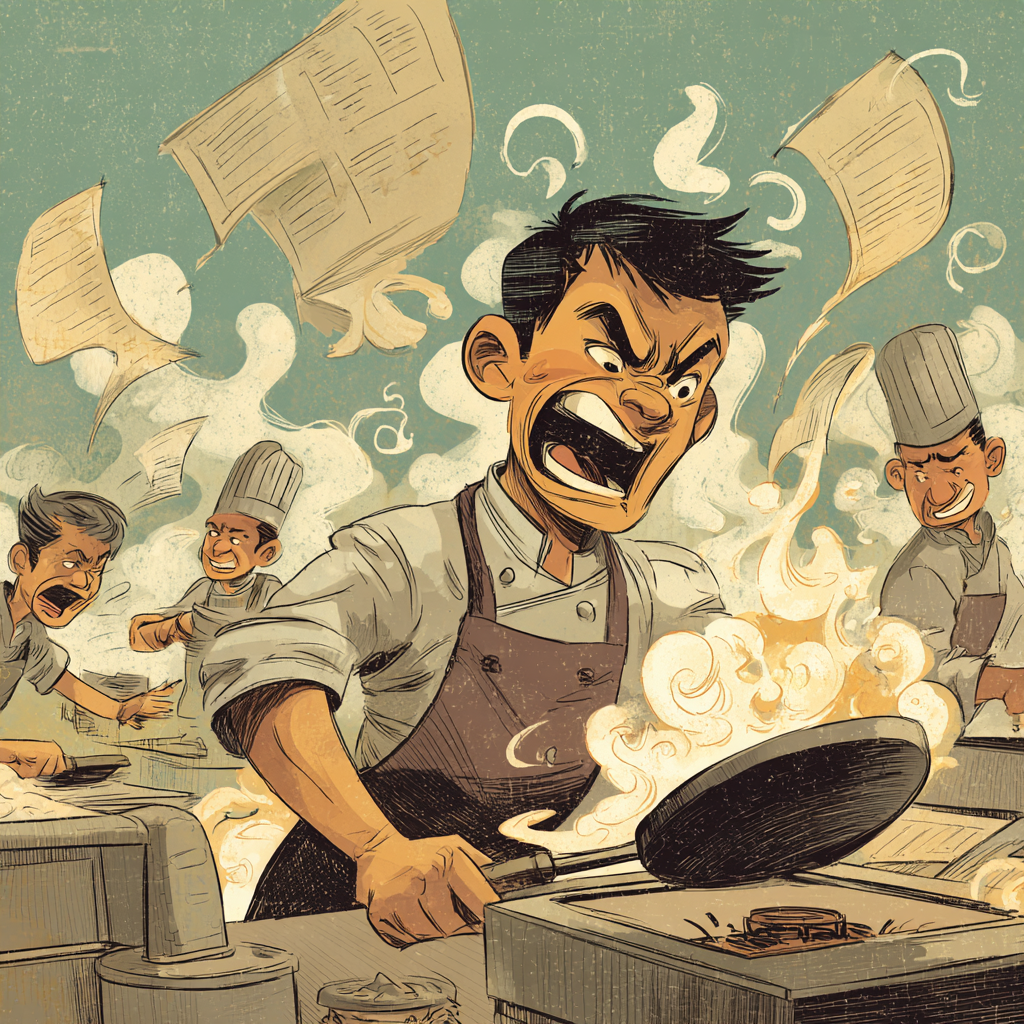
Why a Pan Hitting Steel Is Still the Best Music
I miss the kitchen sounds more than I should. Pan hitting steel. Professional cooking left marks on me. Burns up both forearms. A knee that predicts rain. Tinnitus from years of hoods and exhaust fans running twelve hours straight. But the thing I think about at 3am isn’t any of that. It’s the sound.
Pan hits steel. Oil cracks. Someone calls “behind” and you don’t flinch because your body already knew. Kitchen sounds aren’t music in any way a musician would recognize. Too loud. No melody. Mostly metal and cursing and the wet slap of protein hitting a flat-top. But I’ve never heard anything in a concert hall that made me feel necessary. A concert hall is where you sit and consume. A kitchen is where you are required.
Eddie. Garde manger station. Cold apps. He’d been inside. Two years. Something about assault, nobody asked twice. The kitchen was the first place that hired him same day, no questions. Chef asked if he could hold a knife. Eddie said yes. That was it.
Garde manger was his kingdom. He could break down a case of endive in the time it took most people to read a ticket. Hands like baseball mitts. Tattoo of his daughter’s name on his neck—Marisol. Drove a better car than the sous chef. He ran numbers out of the walk-in and nobody mentioned it because Eddie also kept a rhythm that didn’t falter. Tap the tongs. Flip the plate. Wipe. When Friday service started and the printer screamed, his rhythm got tighter. More precise. Like he’d been waiting his whole life for the noise to mean something.
I want to tell you the kitchen saved Eddie. That’s the story that works. Misfit finds belonging on the line. Bourdain wrote about it—”all line cooks share the same sense of being outsiders.” The kitchen as the last meritocracy. You either keep up or you don’t. Nobody cares about your record, your degree, what you did before.
He worked four years. Then six days became seven. Then the drinking got worse. Then he stopped showing up. Last I heard: drywall in Bayonne.
I didn’t call. Didn’t ask around. Just noticed one day the station sounded different and moved on. That part I don’t like thinking about. How fast the line fills the gap. How fast you forget the specific sound someone made and replace it with whoever’s next.
The ticket machine is the heartbeat. Everything else syncs to it. The printer fires and the whole line tenses. Not fear exactly. Anticipation. Like the split second before a wave hits you.
Then it’s all sound. Pan on burner. Sizzle. “Fire two lamb, one salmon, hold the fennel.” “Heard.” Metal on metal. The clang of a sauté pan landing on the flat-top because your hands are full and you need it hot in thirty seconds. Plate scraping the pass. “Pick up, table nine.” Footsteps. The squeak of clogs on wet tile.
74% of chefs report sleep deprivation to the point of exhaustion. The industry turned over 75% of its workers last year. Bureau of Labor Statistics. Forbes. Not abstractions. Real bodies walking out back doors.
But here’s what nobody puts in those reports. During service, when the rhythm locks in—when every station is firing together and the tickets are coming and you’re moving without thinking—your rent doesn’t exist. Your ex doesn’t exist. There is only the next plate. The next call. Pan hits steel. You answer.
I’ve done drugs that couldn’t touch that feeling.
Because anything that feels that obliterating, that total—you’ll forgive it almost anything. The shit pay. The twelve-hour doubles. The fact that it ate your marriage. Your knees shot at forty-two and you can’t afford the surgery. You’ll forgive it because during those three hours of locked-in service, you were something. You were required.
I talked to a cook last month. Young guy. Twenty-four. Works the grill at a place in Brooklyn. Arms already scarred. He said something that sat in my chest for days. “I don’t love it every night. But when it’s locked in, when the whole line is moving—I don’t think about anything else.” He said it like it was simple. Like it was enough.
I almost said something. Some warning. Didn’t. Who the hell am I? I’m the guy who left. Got out. Writes about it from a safe distance. He’s not romanticizing anything. He’s describing what the work gives him. The rhythm. The belonging. The obliteration.
Bourdain believed it—the kitchen as the only order in otherwise chaotic lives. He wasn’t wrong. But I’ve started to wonder if what the kitchen actually gave us was permission to never build order anywhere else. The rhythm was so consuming, so total, it replaced everything. Relationships. Sleep. Health. Planning. A future. Pan’s loud enough you don’t have to think. Best anesthesia I ever found.
But that kid in Brooklyn. He goes climbing on Mondays. Has a girlfriend who picks him up after close. Doesn’t drink. Told me he’s saving for culinary school, then laughed and said maybe not, maybe a taco truck instead. He loves the work and it hasn’t cost him anything yet. Maybe it won’t. Maybe the kitchen didn’t wreck Eddie. Maybe Eddie and I just needed something loud enough to not think, and the kitchen was there.
Two in the morning. Brooklyn. Garlic and fryer oil on my hands. Not even my kitchen.
I pass a restaurant shutting down for the night. Through the window, someone’s stacking chairs. From the back, muffled—metal on metal. A pan dropped in a dish pit.
The last ugly note of the night.
I stop walking. I stand there longer than makes sense.
